
AI can give you an answer in seconds.
But getting an answer is not the same thing as learning.
Real learning happens when you understand an idea, recall it without assistance, apply it to a problem, recognize your mistakes, connect it to what you already know, and eventually use it in a new situation.
That is the idea behind the growing collection of free Vibe Learning tools available at:
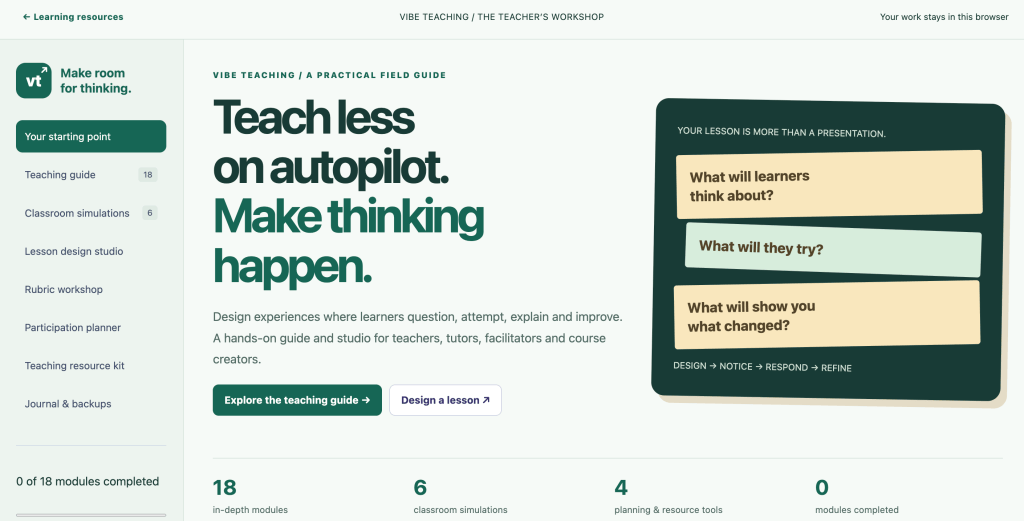
These tools are designed to help you move beyond simply asking AI questions. Instead, they help you use AI as a tutor, coach, practice partner, feedback system, and learning companion.
What Are the Vibe Learning Tools?
The Vibe Learning tools are practical interactive resources built around the Vibe Learning approach to AI-assisted learning.
Instead of starting with:
“Give me the answer.”
the tools encourage questions such as:
“What do I actually understand?”
“What should I practice next?”
“Can I explain this without looking it up?”
“Where are the gaps in my knowledge?”
“Can I apply this idea in a different situation?”
That small change in how we interact with AI can completely change the learning experience.
The goal isn’t to make AI do more thinking for you.
The goal is to use AI to help you become a better thinker and learner.
One Learning System, Multiple Tools
Different stages of learning require different kinds of support.
Sometimes you need to understand a concept.
Sometimes you need practice.
Sometimes you think you understand something but need to test yourself.
Other times you need feedback, retrieval practice, a project, or simply help deciding what to learn next.
The Vibe Learning tools are designed to support these different moments in the learning process.
They fit into a broader learning loop:
Orient → Understand → Predict → Apply → Feedback → Recall → Connect → Transfer
Instead of treating learning as consuming information, this approach treats learning as an active cycle.
Build a Learning Path
A big topic can quickly become overwhelming.
What should you learn first?
What are the prerequisites?
Which concepts matter most?
What can wait until later?
A learning-path tool can help turn a broad goal into a structured sequence of smaller learning objectives.
For example, instead of saying:
“I want to learn JavaScript.”
you might define a more useful outcome:
“I want to learn enough JavaScript to build an interactive quiz without following a tutorial.”
Now AI has a destination.
Your learning can be organized around what you actually want to accomplish rather than an endless list of topics.
Create Better AI Learning Prompts
The quality of an AI learning session often depends on the quality of the prompt.
A vague prompt such as:
“Teach me CSS.”
can produce a huge amount of information without necessarily creating much learning.
A stronger prompt can ask AI to:
- explain a concept at your current level
- ask questions before giving answers
- provide progressively harder examples
- challenge your assumptions
- test your recall
- diagnose mistakes
- create practice exercises
- evaluate your explanation
- help you apply the concept to a project
The tools help turn AI prompting into part of the learning process rather than simply a way of requesting information.
Learn Through Prediction
One of the easiest ways to remain mentally active when using AI is to make a prediction before seeing the explanation.
Before asking AI what will happen, decide what you think will happen.
Then compare your reasoning with the result.
This creates an important learning moment.
You aren’t just reading information.
You are testing your existing mental model against new information.
When your prediction is wrong, the difference becomes something worth investigating.
Practice Active Recall
Rereading something can make it feel familiar.
Unfortunately, familiarity can easily be mistaken for mastery.
A better question is:
Can you remember it without looking?
Active recall forces your brain to retrieve information instead of simply recognizing it.
The Vibe Learning approach encourages AI-assisted retrieval sessions where AI asks questions first and explanations come afterward.
That changes AI from an answer generator into something much closer to a practice partner.
Teach It Back
One of the strongest tests of understanding is surprisingly simple:
Explain the concept yourself.
Try explaining an idea without notes as though you were teaching someone encountering it for the first time.
Then let AI examine your explanation.
It can look for:
- missing steps
- unclear reasoning
- incorrect assumptions
- unexplained terminology
- weak examples
- important concepts you skipped
The important part is that you explain first.
AI evaluates and challenges your understanding rather than replacing it.
Turn Mistakes Into Learning Data
Mistakes are useful.
Instead of simply correcting an incorrect answer and moving on, you can investigate why the mistake happened.
Was it a misunderstanding?
Did you forget something?
Did you choose the wrong strategy?
Did you understand the concept but make an execution error?
That distinction matters.
Once you understand the reason behind a mistake, AI can help generate targeted practice designed specifically around that weakness.
A mistake becomes information about what you should learn next.
Move From Knowledge to Projects
Eventually, learning needs to leave the conversation window.
Build something.
Write something.
Solve something.
Design something.
Explain something.
Projects reveal gaps that are difficult to discover by reading explanations or answering simple questions.
They also produce evidence of learning.
Instead of saying:
“I studied JavaScript.”
you can say:
“I built an interactive application with JavaScript.”
That is a much stronger measure of progress.
Test Transfer, Not Just Repetition
There is another important test of mastery:
Can you use what you learned when the situation changes?
If you learned a technique from one example, try applying it to a different problem.
Change the requirements.
Change the context.
Add a constraint.
Combine it with another skill.
Ask AI to create situations where the obvious solution no longer works.
This tests whether you memorized an example or actually developed a reusable skill.
Build a Personal Learning System
Individual AI conversations are useful, but they can easily become disconnected.
A better approach is to build a system around your learning.
Capture important concepts.
Record mistakes.
Track what you can explain.
Save useful learning artifacts.
Review concepts later.
Connect related ideas.
Build projects that use several skills together.
Over time, your AI conversations stop being isolated interactions and become part of a larger personal knowledge system.
Stop Asking AI to Make Learning Easier
This may sound strange, but the goal shouldn’t always be to make learning easier.
Sometimes learning needs friction.
You need to struggle with a question.
You need to attempt an explanation.
You need to make a prediction.
You need to retrieve something from memory.
You need to make mistakes.
AI can remove almost all of that friction.
Used poorly, that can actually reduce learning.
Used well, AI can create productive struggle: challenges that are difficult enough to make you think but structured enough that you can continue making progress.
That is one of the central ideas behind Vibe Learning.
A Better Question to Ask AI
The AI era has made answers incredibly inexpensive.
That means the valuable skill is changing.
The question is no longer simply:
“Can I find the answer?”
Increasingly, it is:
“Can I understand it, evaluate it, remember it, apply it, and create something useful from it?”
Those are human capabilities worth developing.
And that is exactly what the Vibe Learning tools are designed to support.
Explore the Free Vibe Learning Tools
Whether you’re learning programming, mathematics, writing, design, business, science, AI, or almost any other subject, you can use these tools to create a more active learning experience.
Explore the tools here:
You can also explore the complete Vibe Learning website:
The goal of Vibe Learning is simple:
Use AI to accelerate learning without outsourcing the thinking that makes learning valuable.
Don’t just collect more answers.
Build understanding. Practice deliberately. Test yourself. Create something. Reflect. Then keep learning.