
Discover how to learn faster, think deeper, teach more effectively, and turn AI into a powerful learning partner.
By Laurence Lars Svekis | Creator of the Vibe Learning Framework and Vibe Teaching
The Problem with How We Use AI for Learning
Imagine you’re learning something new.
Maybe it’s JavaScript, a foreign language, mathematics, digital marketing, or a completely unfamiliar subject.
You open ChatGPT or another AI assistant and ask:
“Explain this topic to me.”
Within seconds, you receive a detailed explanation.
You read it. It makes sense. You feel like you’ve learned something.
But here’s the important question:
Could you explain that same concept tomorrow without AI?
That’s where the difference between receiving information and actually learning becomes clear.
AI has made accessing knowledge incredibly easy. But accessing knowledge isn’t the same as understanding, remembering, or applying it.
This is one of the challenges I wanted to address when I developed the Vibe Learning Framework in 2025.
After more than two decades of developing online courses and teaching technology, I recognized that AI could do much more than provide answers.
It could become a learning partner.
And for educators, it could become a teaching assistant that helps create more engaging, adaptive, and meaningful learning experiences.
That thinking led to two connected concepts:
- Vibe Learning: A structured approach to learning with AI through curiosity, exploration, understanding, practice, feedback, and reflection.
- Vibe Teaching: An approach to teaching that uses AI to guide instruction, create learning experiences, and support individual learners.
Today, I want to share 10 practical techniques you can start using immediately.
For additional guidance, explore the free resources at:
1. Stop Asking AI for Answers. Start Asking It to Teach.
One of the most powerful changes you can make is to change the role you assign to AI.
Instead of treating AI as a search engine, treat it as a tutor.
Traditional prompt:
“Explain JavaScript functions.”
Vibe Learning prompt:
“Act as my JavaScript tutor. Help me understand functions through simple explanations and examples. Ask me questions to check my understanding, and give me small challenges before moving to more advanced concepts.”
Notice the difference.
The first prompt requests information.
The second creates an interactive learning experience.
Try this yourself
Choose something you want to learn and ask AI to:
- Assess what you already know.
- Explain one concept at a time.
- Ask you to explain it in your own words.
- Provide a practical exercise.
- Give feedback before introducing the next concept.
The takeaway: AI becomes more valuable when it helps you think rather than simply doing the thinking for you.
2. Use Socratic Questioning to Develop Deeper Understanding
Great teachers don’t always provide immediate answers.
Sometimes they ask questions that lead students toward discovering answers themselves.
This is called the Socratic method, and AI can support it remarkably well.
Imagine a student struggling with a programming problem.
Instead of generating the finished code, AI might ask:
- What result are you expecting?
- What does your code currently produce?
- Which part of the program controls that behavior?
- What could you test to narrow down the problem?
Each question encourages the learner to investigate.
Practical prompt
“Act as a Socratic tutor. Help me solve problems by asking guiding questions. Do not immediately provide the solution. Give me hints when needed and encourage me to explain my reasoning.”
Why it matters: Understanding improves when learners actively construct explanations instead of passively accepting information.
For teachers, this approach can help create guided activities that encourage independent reasoning.
3. Build a Learning Path Instead of Learning Randomly
AI makes it tempting to jump between topics.
You start learning JavaScript, discover APIs, move into databases, and suddenly you’re exploring machine learning.
Curiosity is valuable, but without structure, learning can become fragmented.
Vibe Learning combines curiosity with purposeful progression.
A simple learning structure
<escape>Explore → Understand → Practice → Feedback → Reflect → Apply</escape>
For example, if you’re learning CSS:
Explore: What is CSS, and why do websites use it?
Understand: Learn selectors, properties, and layout concepts.
Practice: Style a simple webpage.
Feedback: Ask AI to review your approach and explain improvements.
Reflect: Identify what you understand and what still feels confusing.
Apply: Build a small responsive webpage without following a complete tutorial.
Practical prompt
“Create a beginner-friendly learning path for CSS. Break it into small milestones. Include explanations, hands-on exercises, review questions, and practical projects. Only advance when I demonstrate understanding.”
The takeaway: A good learning journey has direction, but it should also adapt to the learner.
4. Use Active Recall to Remember What You Learn
Reading an explanation repeatedly can create a feeling of familiarity.
But familiarity isn’t necessarily memory.
One of the most useful learning strategies is active recall — attempting to retrieve information from memory without looking at the answer.
AI makes it easy to create personalized recall exercises.
Try this five-minute activity
After learning a topic:
- Close your notes.
- Write down everything you remember.
- Ask AI to generate five questions about the topic.
- Answer without assistance.
- Review the explanations for anything you missed.
Practical prompt
“Test my understanding of JavaScript arrays with five questions, one at a time. Don’t reveal the answers until I respond. Explain my mistakes and revisit concepts I struggle with.”
This approach is especially useful when combined with spaced review over several days.
The takeaway: Don’t just reread what you learned. Practice remembering it.
5. Turn AI Feedback into a Learning Opportunity
Feedback is essential for improvement.
But not all feedback is equally useful.
If AI simply tells you that your answer is wrong and supplies the correct response, you may miss the opportunity to understand your mistake.
Better feedback explains what happened and encourages improvement.
A better feedback process
Suppose a student writes a short essay.
Instead of asking AI to rewrite it, the student could request:
“Review my essay for clarity, organization, and reasoning. Identify three strengths and three areas for improvement. Explain why each improvement matters, but let me revise the essay myself.”
Now the learner remains responsible for the work.
For educators, AI can also help develop assessment rubrics, formative feedback, and targeted practice activities.
The takeaway: The best feedback helps learners understand how to improve, not just what to correct.
6. Make Learning Personal Without Lowering Expectations
Every learner brings different experiences, interests, and background knowledge.
Someone learning percentages might understand the concept better through shopping discounts.
Another learner might prefer sports statistics or business examples.
AI can adapt explanations to these different contexts.
Practical prompt
“Explain percentages using examples from running a small online business. Start with simple examples, then gradually introduce more challenging problems. Ask me to solve each problem before showing the answer.”
Teachers can apply the same approach to generate alternative explanations or examples for students with different interests.
However, personalization shouldn’t mean avoiding difficult concepts.
The goal is to make learning accessible while maintaining meaningful challenges.
7. Learn by Building Something Real
One of my favorite approaches to learning technology is project-based learning.
You can watch hours of programming tutorials and still struggle to build something independently.
But when you work on a real project, you encounter decisions, problems, and opportunities that passive learning rarely provides.
AI can help turn almost any subject into a practical project.
Example: Learning JavaScript
Instead of only studying variables, arrays, and functions, build a simple quiz application.
Ask AI:
“I want to learn JavaScript by building a quiz application. Break the project into small learning tasks. Explain the concepts I need at each stage, but let me attempt the implementation before providing solutions.”
Your learning path might include:
- Creating the quiz interface
- Storing questions in arrays
- Using functions to check answers
- Updating scores
- Displaying results
- Improving the user experience
Each feature becomes an opportunity to apply a concept.
The takeaway: Projects connect knowledge with practical skills.
8. Use Reflection to Turn Experience into Understanding
Learning doesn’t end when you complete an exercise.
Reflection helps you recognize what you’ve learned, where you struggled, and what to do next.
This is an important part of the Vibe Learning Framework.
After completing a lesson or project, ask yourself:
What did I learn?
What surprised me?
What was difficult?
Could I explain this to someone else?
Where could I apply this knowledge?
Practical prompt
“Help me reflect on today’s learning session. Ask me five thoughtful questions, one at a time, about what I understood, what challenged me, and how I can apply what I learned.”
For teachers, reflection can become a regular classroom activity or learning journal exercise.
The takeaway: Reflection helps learners become more aware of their own learning process.
9. Apply Vibe Teaching to Create Better Learning Experiences
Now let’s look at the other side of education.
What changes when teachers start using AI more intentionally?
Vibe Teaching isn’t about replacing the educator.
It’s about giving educators additional ways to design, support, and improve learning.
Imagine preparing a lesson about climate change, mathematics, or computer programming.
AI can help develop:
- Engaging introductory questions
- Different explanations of difficult concepts
- Interactive classroom activities
- Practice questions and assessments
- Real-world examples
- Discussion topics that encourage critical thinking
Example teaching prompt
“Act as an instructional design assistant. Help me create a 30-minute beginner lesson about JavaScript variables. Include an engaging opening question, a simple explanation, an interactive activity, three comprehension questions, and a short reflection exercise.”
The teacher reviews the material, checks accuracy, adjusts the difficulty, and guides the classroom experience.
AI assists with preparation.
The teacher provides the human judgment, encouragement, and understanding that effective education requires.
The takeaway: AI can support better teaching when educators remain actively involved in designing and guiding learning.
10. Create a Continuous Learning Cycle
The most important lesson is that learning isn’t a single event.
It’s an ongoing process.
This is why the Vibe Learning Framework emphasizes a connected learning cycle:
Curiosity → Explore → Understand → Practice → Feedback → Reflect → Connect → Create → Share → Reinvent
Consider what happens when you learn a new programming concept.
You become curious about it.
You explore examples.
You develop an understanding.
You practice.
You receive feedback.
You reflect on your progress.
You connect the concept to something you already know.
You create a project.
You share your results.
Then you discover something new you want to learn.
The cycle begins again.
AI can support every stage, but the learner remains at the center of the experience.
Put It into Practice: Your Next 15-Minute AI Learning Session
You don’t need a complicated system to start using these ideas.
Try this simple activity today.
Minutes 1–3: Choose and explore
Pick one concept you want to understand. Ask AI to assess your existing knowledge and introduce the topic.
Minutes 4–7: Learn through questions
Ask AI to explain the concept, then guide you through a few questions that require reasoning.
Minutes 8–11: Practice
Complete a small challenge without immediately requesting the solution.
Minutes 12–13: Get feedback
Ask AI to review your answer and identify one improvement.
Minutes 14–15: Reflect
Explain what you learned in your own words and identify your next learning goal.
This short exercise brings several Vibe Learning principles together.
And it demonstrates an important idea:
The value of AI in education isn’t measured by how much information it produces, but by how much meaningful learning it helps create.
Explore the 10 Free Vibe Learning and Teaching Guides
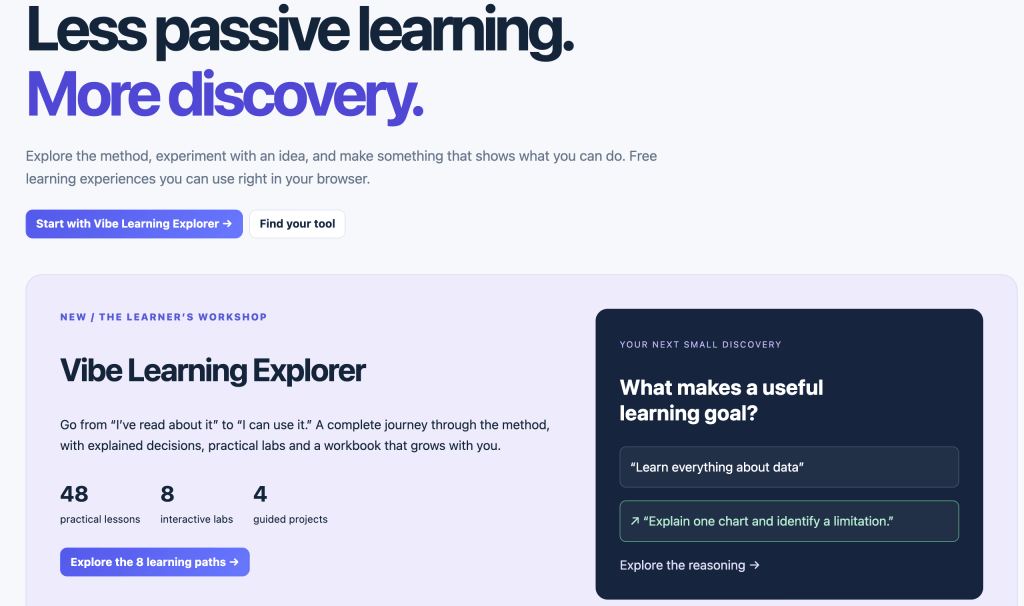
The techniques in this article are starting points.
If you want to go deeper, I’ve brought together a collection of 10 free learning and teaching resources at VibeLearning.ca.
The collection is designed to help you explore structured AI-assisted learning, guided practice, effective prompting, teaching workflows, feedback, reflection, and practical applications.
Whether you’re an educator preparing lessons, a student trying to understand a difficult subject, a professional developing new skills, or someone who simply loves learning, these resources can help you explore new approaches.
Explore the free tools and guides here:
You can experiment with the techniques, adapt them to your own goals, and develop a learning process that works for you.
Why I Believe This Matters
I’ve been developing online learning experiences since 2001.
During that time, I’ve seen major changes in how people access education.
We moved from traditional classroom materials to online courses, video tutorials, interactive exercises, and self-paced learning platforms.
AI represents another major shift.
But I don’t believe the future of learning should be about generating more content or giving students faster answers.
It should be about creating better learning experiences.
When I began developing Vibe Learning in March 2025 and launched the framework that May, my goal was to bring more structure and purpose to AI-assisted learning.
Vibe Teaching extends that philosophy to educators, helping them think about how AI can support teaching, guided exploration, and meaningful student engagement.
Both approaches share one central belief:
Technology should strengthen human learning, not replace human thinking.
One Final Question
Imagine two students using AI to learn the same subject.
One asks AI for every answer.
The other asks AI to explain concepts, challenge their understanding, provide feedback, and guide their practice.
After a month, which student do you think will have developed stronger independent skills?
That’s the conversation I want to encourage.
AI can give us answers. But can we use it to become better thinkers, learners, and teachers?
I believe we can — if we approach it intentionally.
💬 I’d love to hear from you:
How are you using AI to support learning or teaching? Are you using it mainly for answers, or have you started using it as an interactive learning partner?
Share your experiences in the comments.
Explore the 10 free guides:
Learn more about Vibe Learning and Vibe Teaching:
Laurence Lars Svekis
Web Developer | Online Educator | Creator of Vibe Learning and Vibe Teaching
#VibeLearning #VibeTeaching #AIinEducation #ArtificialIntelligence #EdTech #TeachingWithAI #LearningWithAI #FutureOfEducation #GenerativeAI #LifelongLearning #ActiveLearning #InstructionalDesign #PersonalizedLearning #EducationInnovation