
3 Free Interactive Vibe Learning Tools That Turn Curiosity into Real Skills
By Laurence Lars Svekis | Creator of Vibe Learning and Vibe Teaching
What If Learning Felt More Like Playing a Game?
Think about the last time you played a really engaging game.
You probably didn’t begin by reading a 50-page instruction manual.
Instead, you explored.
You tried something.
You made a decision.
Sometimes you succeeded. Sometimes you failed.
You learned from what happened and tried again.
And before you knew it, you had developed skills you didn’t have when you started.
Now imagine bringing that same experience into education.
What if learning JavaScript, understanding AI, improving your critical thinking, or developing professional skills could feel more like an adventure?
What if learners were encouraged to make decisions, investigate problems, experiment with solutions, and discover concepts through experience?
That’s the thinking behind three interactive learning experiences I’ve created as part of the Vibe Learning ecosystem.
Today, I’m introducing:
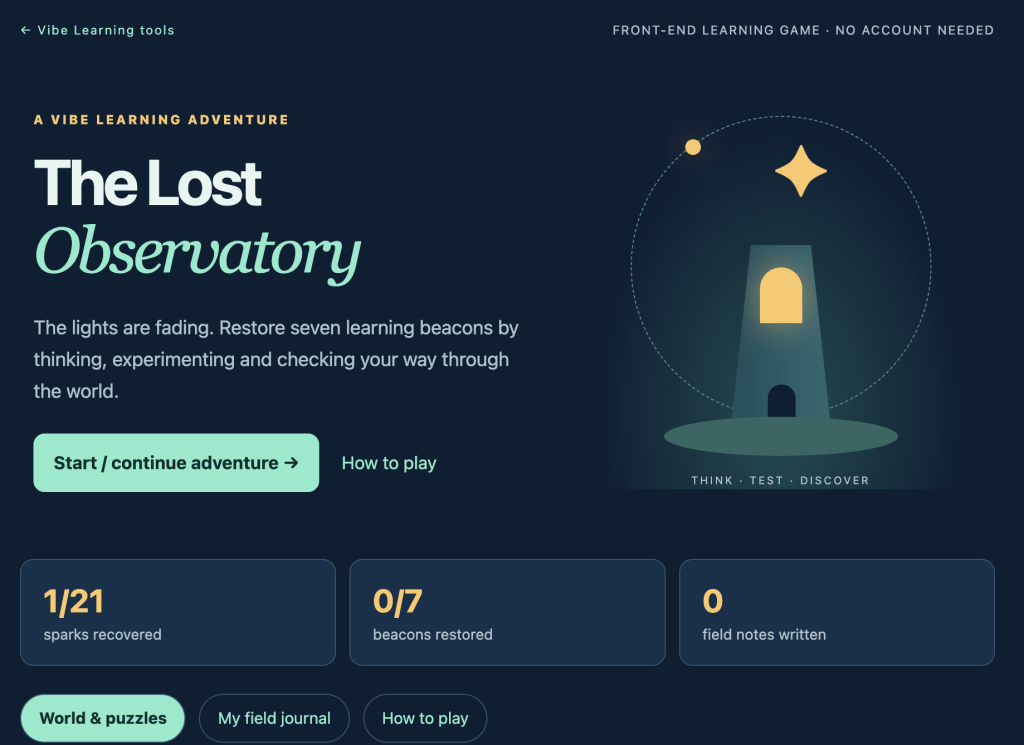
🎮 The Lost Observatory — Vibe Quest Game
🧭 AI Learning Adventure II — From Practice to Judgment

🚀 AI Learning Adventure — From Beginner to Independent Learner
All three are free, browser-based learning experiences designed around one important principle:
Learning happens when you actively engage with ideas, not simply when you consume information.
Let’s explore why this matters, how to apply these principles to your own learning, and how each tool can help.
1. Why Traditional Learning Often Falls Short
Consider a familiar learning experience.
You watch a tutorial.
The instructor explains a concept.
You follow along and everything seems clear.
Then you try to apply the same concept independently.
Suddenly, things become much more difficult.
Why?
Because recognizing an explanation isn’t the same as being able to use what you’ve learned.
There are several different levels of learning:
Exposure: You’ve encountered the information.
Understanding: You can explain what it means.
Application: You can use it to solve a problem.
Adaptation: You can apply it in an unfamiliar situation.
Independent judgment: You can evaluate alternatives, justify decisions, and recognize limitations.
Many learning experiences focus heavily on the first two levels.
But real-world skills require much more.
This is where interactive, challenge-based learning becomes valuable.
Instead of asking, “Have you read the lesson?”
We can ask:
“What can you actually do with what you’ve learned?”
That small change can transform the entire learning experience.
2. The Science Behind Learning Through Challenges
Several well-established learning principles help explain why interactive challenges can be effective.
Active learning
Learning improves when people participate in the process.
Rather than passively reading about a concept, learners investigate problems, answer questions, compare possibilities, and apply ideas.
For example, imagine learning about website accessibility.
A passive approach might explain why color contrast matters.
An active approach might present two interface designs and ask:
“Which design would be easier to read, and how would you verify your choice?”
Now you’re applying the concept.
Retrieval practice
Retrieval practice involves recalling information without simply rereading the explanation.
Imagine completing a lesson about JavaScript functions.
Instead of reviewing the same material again, you might be asked:
“Without looking at your notes, explain what a function parameter does.”
Attempting to retrieve the answer strengthens your ability to remember and use the concept.
Learning through feedback
Feedback helps learners understand the relationship between their decisions and outcomes.
A useful learning challenge doesn’t simply announce whether an answer is correct.
It encourages you to consider:
- Why did this approach work?
- What assumption did I make?
- What evidence supports my decision?
- What could I try differently?
Reflection
Reflection helps turn an experience into something you can learn from.
After completing a challenge, ask:
“What did I understand better after this experience?”
“What would I do differently next time?”
“Where could I apply this skill?”
These principles are central to the way I approach Vibe Learning.
Introducing 3 Free Interactive Vibe Learning Adventures
Each of these tools approaches learning from a different perspective.
One uses a game world and puzzles.
Another develops foundational independent learning skills.
The third challenges learners to evaluate evidence, defend conclusions, and exercise better judgment.
Together, they offer different ways to practice the habits of effective learning.
🎮 Tool 1: The Lost Observatory — Vibe Quest Game
Learn through exploration, experimentation, and problem-solving.
https://vibelearning.ca/tools/vibe-quest-game
Imagine entering a mysterious world where the lights are fading.
Your mission?
Restore seven learning beacons by thinking, experimenting, and solving challenges.
But there’s a catch.
You can’t simply memorize your way through the adventure.
You need to investigate, make decisions, test your thinking, and learn from feedback.
What makes this experience different?
The Lost Observatory turns learning principles into a fictional adventure.
Instead of reading about problem-solving, you practice it.
Instead of simply hearing that experimentation matters, you experience a sequence of challenges that encourages you to test ideas.
The experience includes:
- Seven learning beacons to restore
- Interactive puzzles and decisions
- Built-in feedback
- A field journal for tracking progress
- Browser-based progress saving
- A downloadable version for offline play
The game uses fictional challenges and built-in feedback rather than a connected AI model.
What can you learn from it?
Lesson 1: A wrong answer can be useful.
When an experiment doesn’t produce the expected result, you’ve discovered something about your assumptions.
Lesson 2: Curiosity drives exploration.
Questions create opportunities to investigate rather than simply accept information.
Lesson 3: Progress comes from iteration.
Try something, examine the outcome, adjust your approach, and try again.
Try this learning technique
The next time you’re struggling with a problem, use this three-step approach:
Predict: What do you think will happen?
Test: Try your idea and observe the result.
Explain: Why did the result occur?
For example, when learning JavaScript, predict what a short function will output before running it.
Then compare the result with your prediction.
If you were wrong, investigate why.
That small habit can make practice much more meaningful.
Who should try it?
Curious learners, students, educators, and anyone interested in experiencing learning through puzzles and exploration.
👉 Play The Lost Observatory:
https://vibelearning.ca/tools/vibe-quest-game
🚀 Tool 2: AI Learning Adventure — From Beginner to Independent Learner
Learn how to approach unfamiliar problems, make decisions, and develop independence.
https://vibelearning.ca/tools/ai-learning-adventure
One of the biggest challenges with AI-assisted learning is knowing when to ask for help and when to attempt something yourself.
AI can provide an answer in seconds.
But if you’re always receiving completed solutions, are you developing the skills needed to solve problems independently?
AI Learning Adventure explores this challenge.
What does the adventure include?
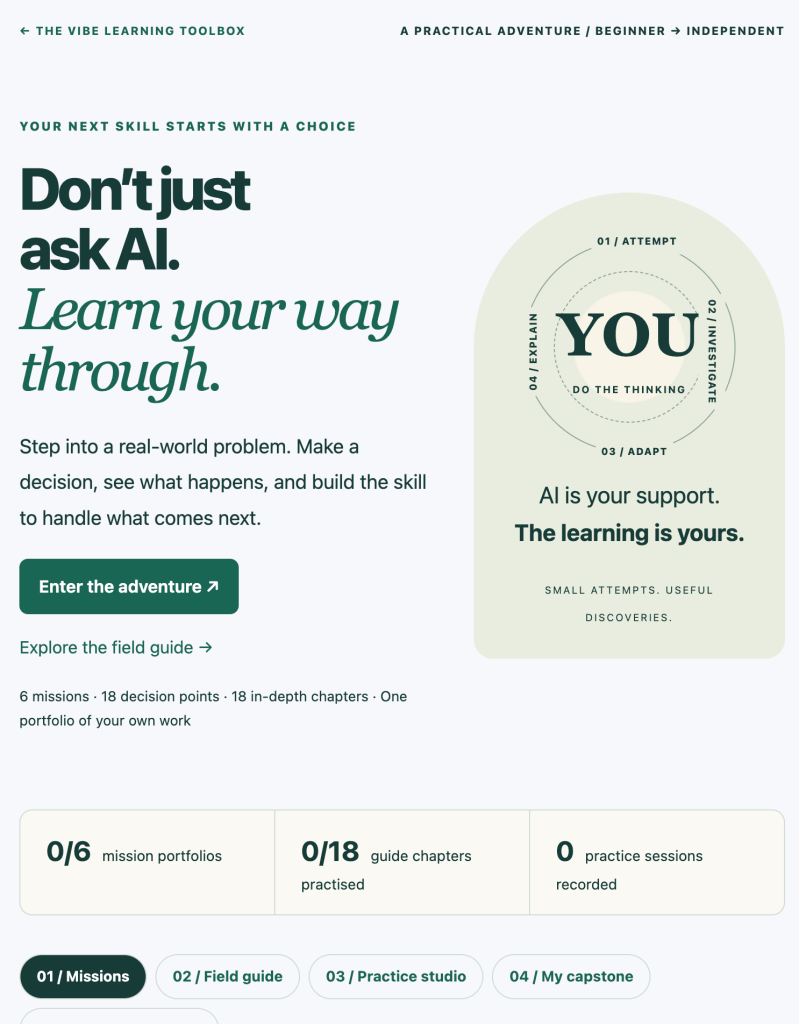
This interactive learning experience offers:
- 6 missions
- 18 decision points
- 18 in-depth learning chapters
- A practice studio
- A personal capstone project
- A learning journal and downloadable backups
The experience guides learners through practical scenarios where decisions matter.
Rather than simply receiving instructions, you choose an approach, examine outcomes, and consider how to improve.
The key learning principle: Attempt before assistance
Imagine you’re learning how to analyze data.
You encounter a spreadsheet with inconsistent information.
Your first instinct might be to ask AI:
“Clean this data for me.”
But what if you tried something different?
Ask yourself:
“What problems can I identify before asking AI for help?”
You might notice missing values, inconsistent dates, or duplicate records.
Now, when you ask AI for assistance, you already have a better understanding of the problem.
This changes your relationship with AI.
You’re no longer simply delegating the task.
You’re actively learning how to approach it.
A practical prompt to try
“Act as my learning coach. I want to develop my ability to solve problems independently. Give me a small challenge related to [topic]. Let me attempt it first. Then ask me to explain my reasoning, identify gaps in my understanding, and suggest a useful next exercise.”
You can use this prompt with a separate AI assistant while working through your own learning goals.
The Adventure tool itself does not require an AI account or connect directly to an AI service.
The bigger lesson
AI should support the development of independent skills, not become a substitute for them.
👉 Start AI Learning Adventure:
https://vibelearning.ca/tools/ai-learning-adventure
🧭 Tool 3: AI Learning Adventure II — From Practice to Judgment
Go beyond finding answers. Learn to evaluate evidence, challenge assumptions, and defend your reasoning.
https://vibelearning.ca/tools/ai-learning-adventure-2
The first adventure focuses on building confidence through practice and developing independence.
Adventure II takes the next step.
What happens when the problem isn’t straightforward?
What if two sources disagree?
What if an AI-generated explanation sounds convincing but contains unsupported assumptions?
What if a solution works in one situation but fails in another?
These are the kinds of challenges learners increasingly encounter in an AI-powered world.
What does Adventure II include?
- 6 missions
- 18 decision points
- 18 in-depth chapters
- Scenarios involving conflicting evidence
- A practice studio
- A capstone experience
- A learning journal with separate saved progress
The focus moves beyond completing a task toward explaining and defending your decisions.
Learning principle: A convincing answer isn’t necessarily a correct answer
Imagine asking AI:
“What’s the best programming language for building a web application?”
The AI might confidently recommend one language.
But is that recommendation appropriate for every project?
A stronger learner asks:
“What assumptions does this recommendation depend on?”
“What alternatives should I consider?”
“What evidence supports the conclusion?”
“What circumstances might change the answer?”
This is a critical skill for working effectively with AI.
Try the Evidence Challenge
The next time AI gives you an important recommendation, ask these five questions:
1. What is the claim?
Identify exactly what the AI is recommending.
2. What evidence supports it?
Look for facts, examples, or reliable sources.
3. What assumptions are being made?
Consider what information might be missing.
4. What alternatives exist?
Explore other explanations or solutions.
5. What would change my conclusion?
Identify evidence that could challenge your initial belief.
This approach encourages critical thinking rather than automatic acceptance.
A practical prompt
“Help me evaluate this recommendation critically. Identify its assumptions, possible weaknesses, alternative approaches, and what evidence would be needed to make a well-supported decision. Ask me to form my own conclusion before sharing your assessment.”
The bigger lesson
Knowing an answer is useful. Understanding why it is reasonable — and when it might be wrong — is even more valuable.
👉 Explore AI Learning Adventure II:
https://vibelearning.ca/tools/ai-learning-adventure-2
3. How These Adventures Connect to the Vibe Learning Framework
When I started developing the Vibe Learning Framework in 2025, my goal was to create a more structured way to learn with AI.
Having worked in online education since 2001, I had seen how easily learners could become overwhelmed by information.
AI made information more accessible than ever.
But I believed we needed a stronger focus on how people develop understanding and apply knowledge.
The Vibe Learning Framework follows a connected cycle:
Curiosity → Explore → Understand → Practice → Feedback → Reflect → Connect → Create → Share → Reinvent
These three adventures put different parts of that cycle into practice.
The Lost Observatory emphasizes curiosity, exploration, experimentation, and feedback.
AI Learning Adventure emphasizes practice, adaptation, reflection, and independence.
AI Learning Adventure II emphasizes deeper reasoning, evaluating evidence, recognizing limitations, and explaining conclusions.
The goal isn’t simply to complete missions.
It’s to develop learning habits you can transfer into other areas of your life.
4. A Practical 20-Minute Learning Challenge
You don’t need to spend hours studying to begin applying these ideas.
Try this short activity with any topic you’re interested in.
Minutes 1–5: Explore
Choose a topic you want to understand.
Ask yourself:
“What do I already know?”
“What am I curious about?”
“What specific question would I like to answer?”
Minutes 6–10: Investigate
Find an explanation, example, or problem related to your topic.
Before requesting an AI-generated solution, make your own prediction or attempt.
Minutes 11–15: Test and evaluate
Try applying what you’ve learned.
If you’re studying programming, write a small piece of code.
If you’re studying marketing, analyze a campaign.
If you’re studying mathematics, solve a problem.
Then evaluate your result.
Minutes 16–20: Reflect and improve
Ask:
“What worked?”
“What was difficult?”
“What evidence supports my understanding?”
“What should I practice next?”
Finally, write one sentence explaining what you learned.
The goal isn’t to finish as much content as possible. It’s to develop something you can actually use.
5. What This Means for Teachers and Educators
These ideas aren’t limited to independent learners.
They also connect directly to Vibe Teaching — my approach to using AI to support more engaging, guided, and purposeful learning experiences.
Educators can use similar principles when designing lessons.
Instead of beginning every lesson with an explanation, begin with an interesting problem.
Instead of immediately correcting every mistake, ask students to explain their reasoning.
Instead of assessing only whether students remember information, provide opportunities to apply and defend their understanding.
Example: Teaching programming through missions
Imagine teaching JavaScript functions.
Mission 1: Predict the output of a function.
Mission 2: Identify a mistake in a function.
Mission 3: Modify the function to solve a new problem.
Mission 4: Explain why your solution works.
Mission 5: Compare two possible solutions.
The same concepts can be taught through a sequence of meaningful challenges.
Teachers can also use AI to help brainstorm scenarios, develop differentiated exercises, and create formative assessment questions.
The educator remains responsible for verifying the material and guiding the learning process.
This is the philosophy behind Vibe Teaching:
Use technology to support better learning experiences while keeping learners actively engaged in thinking.
6. Which Adventure Should You Try First?
There isn’t one correct starting point.
Choose based on the experience you’re looking for.
🎮 Want something fun and exploratory?
Start with The Lost Observatory.
https://vibelearning.ca/tools/vibe-quest-game
🚀 Want to develop better independent learning habits?
Start with AI Learning Adventure.
https://vibelearning.ca/tools/ai-learning-adventure
🧭 Want to strengthen critical thinking and decision-making?
Try AI Learning Adventure II.
https://vibelearning.ca/tools/ai-learning-adventure-2
You can begin either AI Learning Adventure independently. Their progress and workbooks are separate.
All three experiences are designed to be accessible through your browser, and the learning adventures provide options for keeping backups of your work.
7. The Future of Learning Should Be More Interactive
I believe we’re entering an exciting period for education.
For years, online learning has been built around lessons, videos, articles, and assessments.
These resources remain valuable.
But AI and interactive technology give us opportunities to make learning more adaptive, exploratory, and participatory.
We can create experiences where learners make decisions instead of simply following instructions.
Where mistakes become opportunities for discovery.
Where questions matter as much as answers.
And where learning is measured not only by what someone remembers, but by what they can explain, create, and apply.
That’s the future I want to help build through Vibe Learning and Vibe Teaching.
Not learning where AI does everything for us.
Learning where technology helps us become more capable, curious, and independent.
Explore the Free Vibe Learning Tools
These three adventures are part of a growing collection of interactive learning resources I’ve created to help people learn more effectively.
You can explore the complete toolbox here:
Learn more about the Vibe Learning Framework and Vibe Teaching:
The tools are free to explore, and you can start experimenting with these learning methods immediately.
One Final Question
Think about two different learning experiences.
In the first, you watch someone explain how to solve a problem.
In the second, you enter an interactive challenge, make decisions, experiment, receive feedback, and discover the solution yourself.
Which experience would you find more memorable?
Which one would leave you more confident about tackling a similar problem tomorrow?
I believe the answer points toward an important opportunity in education.
The future of learning isn’t just about better answers. It’s about creating better experiences that help people learn how to think.
💬 I’d love to hear your thoughts.
Would you rather learn something new through a traditional course, an AI tutor, or an interactive adventure?
And how could we make learning feel more like discovery?
Share your thoughts in the comments.
About the Author
Laurence Lars Svekis is a web developer, online educator, author, and creator of the Vibe Learning Framework and Vibe Teaching. With more than 20 years of experience in technology education and over 3 million students taught, he focuses on helping people develop practical skills through modern technology, AI-assisted learning, and hands-on experiences.
Explore Vibe Learning: https://vibelearning.ca/
#VibeLearning #VibeTeaching #AIinEducation #LearningWithAI #Gamification #GameBasedLearning #EdTech #ActiveLearning #FutureOfEducation #ArtificialIntelligence #CriticalThinking #LearningDesign #InteractiveLearning #LifelongLearning #TeachingWithAI