
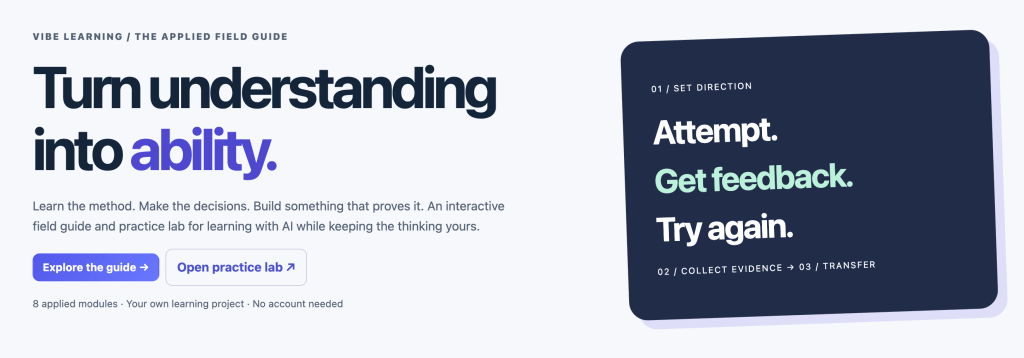
https://vibelearning.ca/advanced-guide
AI has changed how quickly we can access information.
But access to information isn’t the same as learning.
You can ask an AI almost anything and receive an explanation in seconds. You can generate examples, summaries, tutorials, quizzes, code, study plans, and ideas.
The harder question is:
How do you turn all of that AI assistance into real understanding and usable skill?
That is the focus of the new Vibe Learning Advanced Guide.
From AI Answers to AI-Assisted Learning
Vibe Learning is built around a simple idea:
AI should help you think, practice, remember, and create—not simply give you the answer.
The Advanced Guide takes that idea further by showing how to build a more deliberate learning system around AI.
Instead of starting with:
“What should I ask AI?”
Start with:
“What am I trying to learn, what should I be able to do, and what evidence would show that I’ve learned it?”
That small shift changes the entire learning experience.
The Vibe Learning Learning Loop
A powerful learning session can move through a cycle:
Orient → Understand → Predict → Apply → Feedback → Recall → Connect → Transfer
Each stage has a purpose.
Orient
Start by defining the learning mission.
What are you trying to understand or accomplish?
Instead of saying:
“I want to learn JavaScript.”
Create a more useful outcome:
“I want to understand enough JavaScript to build an interactive quiz without following a tutorial.”
A clear destination gives AI—and you—a much better starting point.
Understand
Use AI to build mental models, explanations, examples, analogies, and connections.
But don’t stop at reading the explanation.
Understanding needs to become something you can work with.
Predict
Before asking AI for the answer, make a prediction.
What do you think will happen?
Why?
What would you expect to see?
Prediction creates a reason to think before receiving the explanation, making the eventual feedback more meaningful.
Apply
Now use the idea.
Solve a problem.
Write something.
Build something.
Explain something.
Make a decision.
Application is where information starts becoming capability.
Feedback
Don’t just ask AI:
“Is this correct?”
Ask it to help diagnose why something went wrong.
Was there a concept gap?
A misunderstanding?
A poor strategy?
A missing prerequisite?
Or simply an execution mistake?
The goal isn’t merely to get the correct answer. It’s to understand the difference between your attempt and a better one.
Recall
Close the notes.
Put the explanation away.
Try to reconstruct the idea from memory.
This is one of the most important shifts in AI-assisted learning.
If AI always supplies the information, you may become excellent at recognizing answers without becoming equally good at retrieving or using the knowledge yourself.
Connect
Ask:
- What does this connect to?
- What concepts depend on it?
- Where else could I use it?
- What does this remind me of?
- How is it different from related ideas?
Connections make knowledge more useful.
Transfer
Finally, change the situation.
Use a new example.
Change the constraints.
Try a different problem.
Apply the concept somewhere unfamiliar.
Transfer is one of the strongest tests of whether you actually understand something.
Practice Is Where Learning Becomes Real
One of the biggest risks of AI-assisted learning is becoming a spectator.
AI can explain.
AI can demonstrate.
AI can generate.
AI can solve.
But you still need to attempt.
The Advanced Guide emphasizes deliberate practice, productive struggle, retrieval, feedback, teach-back, mistake analysis, and projects.
That means your learning session might look like this:
- Choose one specific outcome.
- Ask AI for a focused explanation.
- Make a prediction.
- Attempt a problem yourself.
- Get targeted feedback.
- Record an important mistake.
- Recall the concept without your notes.
- Explain it in your own words.
- Try a new application.
- Decide what to learn next.
That is very different from spending an hour asking AI questions and reading the answers.
Your Mistakes Are Learning Data
A mistake isn’t just something to correct.
It can be evidence.
When you make an error, ask:
What caused the mistake?
Maybe you misunderstood the concept.
Maybe you forgot something.
Maybe you recognized the concept but didn’t know when to apply it.
Maybe you chose the wrong strategy.
Maybe you understood the theory but couldn’t execute it.
Each type of mistake suggests a different next step.
This is why a mistake journal can become more valuable than a collection of perfect answers.
Teach It Back
One of the simplest ways to test your understanding is to teach the concept.
Close your resources and explain the idea as if you were teaching an intelligent beginner.
Then use AI as an evaluator.
Ask it to identify:
- factual errors
- vague explanations
- missing connections
- unexplained terminology
- incorrect assumptions
- gaps in your reasoning
Then try the explanation again.
The goal isn’t to make AI produce the perfect explanation.
The goal is to make your explanation better.
Build Evidence of Learning
Confidence matters, but confidence isn’t the same as evidence.
A stronger set of questions is:
- Can I explain it?
- Can I recall it?
- Can I recognize when it applies?
- Can I use it?
- Can I debug it?
- Can I adapt it?
- Can I apply it in an unfamiliar situation?
- Can I teach it?
This moves learning away from simply asking:
“Do I understand this?”
and toward:
“What can I actually do with what I know?”
Projects Turn Knowledge Into Capability
Eventually, learning needs to leave the conversation.
Build something.
Write something.
Solve something.
Create something.
Teach something.
A project combines multiple pieces of knowledge and forces you to make decisions.
It also creates something tangible that can become evidence of what you’ve learned.
That’s why projects are such an important part of the Vibe Learning approach.
The New Role of AI
AI doesn’t have to be your teacher in the traditional sense.
It can become something more flexible:
- a tutor
- a questioning partner
- a practice generator
- a feedback coach
- a project advisor
- a misconception detector
- a retrieval partner
- a reflection assistant
But the learner remains responsible for the important cognitive work.
Think. Predict. Attempt. Retrieve. Explain. Create. Revise.
That’s where learning happens.
Start With One Learning Mission
You don’t need to redesign your entire life around AI.
Start with one topic.
Choose one outcome.
Give yourself 25 minutes.
Then work through a simple cycle:
Understand → Predict → Apply → Feedback → Recall → Transfer
At the end, don’t just ask whether the session felt productive.
Ask:
What can I do now that I couldn’t do 25 minutes ago?
That’s a much more useful measure of progress.
Explore the Advanced Guide
The Vibe Learning Advanced Guide is designed for learners who want to move beyond AI as an answer machine and start using it as part of a structured learning system.
Explore the guide and experiment with the methods yourself:
https://vibelearning.ca/advanced-guide
The future of learning with AI isn’t about letting AI do all the thinking.
It’s about using AI to make your thinking more effective.
Learn with AI. Keep the thinking yours.