
Artificial intelligence is changing how people learn—but it also changes how we need to teach.
When learners can ask AI for explanations, examples, summaries, code, ideas, and even complete answers in seconds, the role of the teacher becomes more important, not less.
The challenge is no longer simply delivering information.
The challenge is creating learning experiences that encourage thinking, questioning, experimenting, reflecting, and creating.
That is the idea behind Vibe Teaching.
I created Vibe Teaching as the educator-focused extension of the Vibe Learning approach: a practical way for teachers, tutors, facilitators, and course creators to rethink learning experiences for an AI-assisted world.
I’ve now turned those ideas into an interactive resource:
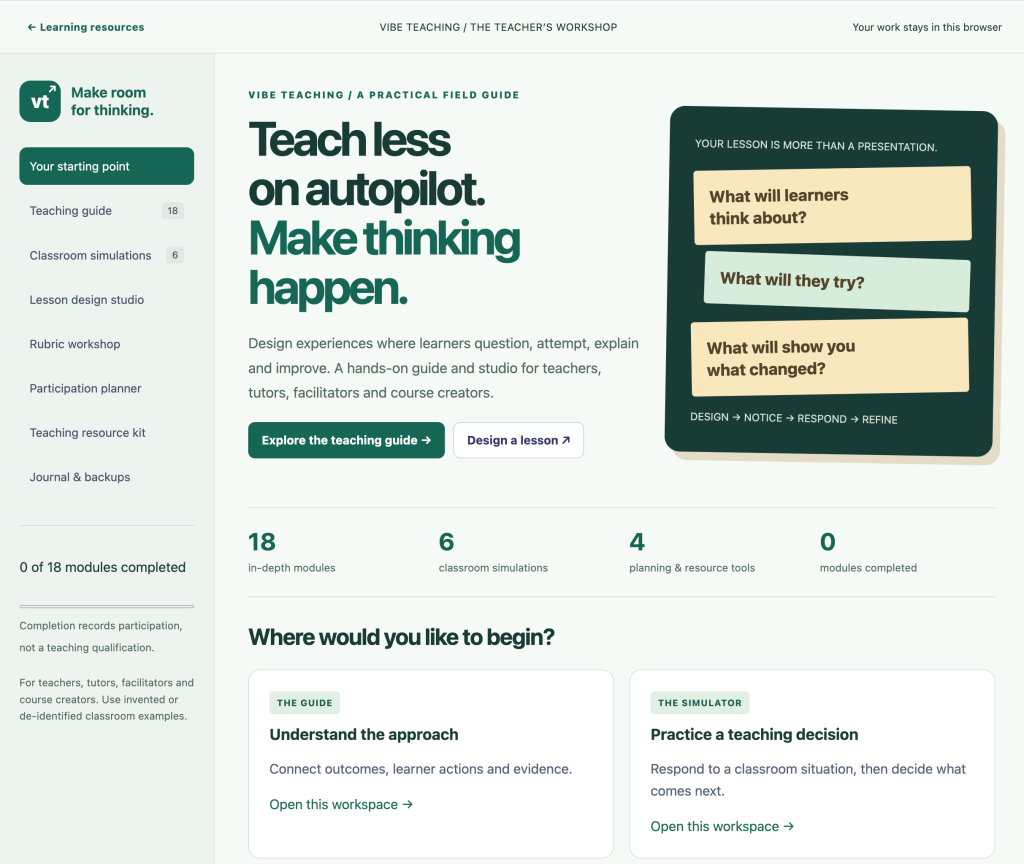
Vibe Teaching — The Teacher’s Workshop
https://vibelearning.ca/tools/vibe-teaching
What Is Vibe Teaching?
Vibe Teaching applies the principles of Vibe Learning from the educator’s perspective.
Instead of asking:
“How can AI teach this for me?”
we can ask a much more useful question:
“How can I design an experience where AI helps the learner think, explore, practice, and create?”
That distinction matters.
AI can generate information very quickly, but information alone does not create understanding.
Learners still need opportunities to make connections, test ideas, make mistakes, receive feedback, reflect on what happened, and apply what they have learned.
Vibe Teaching is about designing for that process.
Introducing the Vibe Teaching Workshop
The Vibe Teaching Workshop is an interactive browser-based resource designed for teachers, tutors, facilitators, instructors, and course creators.
Rather than being another AI chatbot, it provides a structured environment for thinking through your teaching.
The workshop currently includes 18 teaching modules and 6 classroom simulations, along with several practical planning and design tools.
You can explore it here:
https://vibelearning.ca/tools/vibe-teaching
Learn Through 18 Teaching Modules
The teaching guide provides a structured path for exploring Vibe Teaching concepts.
The goal isn’t simply to read about AI in education.
It is to think about how teaching itself can evolve.
As you work through the modules, you can consider how concepts such as curiosity, structure, projects, retention, reflection, and human judgment can become part of the learning experience.
Progress can also be recorded as you move through the material, making the resource useful as a self-directed professional learning workshop.
Experiment With Classroom Simulations
One of my favorite parts of the resource is the Classroom Simulations section.
Teaching decisions rarely have one perfect answer.
A strategy that works well for one learner, classroom, or topic may not work as well somewhere else.
The workshop includes six simulations that let you explore teaching situations and think through possible approaches.
Instead of simply telling educators what they should do, the simulations encourage them to consider:
- What is the learner actually trying to understand?
- Where should AI help?
- Where should the learner struggle productively?
- When should the teacher intervene?
- How can we tell whether genuine understanding has occurred?
That reflective process is at the heart of Vibe Teaching.
Build Better Lessons With the Lesson Design Studio
Knowing educational theory is useful.
Turning it into a good lesson is harder.
The Lesson Design Studio helps bridge that gap by giving educators a workspace for organizing their ideas and designing learning experiences.
Instead of starting with:
“What information do I need to present?”
try starting with:
“What should the learner be able to understand, explain, build, or demonstrate when this experience is finished?”
That shift can completely change how a lesson is designed.
AI can then become part of the learning process rather than simply becoming an answer generator.
Create Better Assessments With the Rubric Workshop
AI also creates new challenges for assessment.
If learners can generate polished text almost instantly, assessing only the final output may tell us less about what they actually understand.
The Rubric Workshop helps educators think about what they really want to evaluate.
That might include:
Understanding. Reasoning. Process. Application. Reflection. Creativity. Communication.
In an AI-assisted environment, the process behind the answer can become just as important as the answer itself.
Plan for Participation
Learning should not be a passive experience.
The Participation Planner helps educators think about how learners will actually interact with a lesson.
Will they investigate?
Discuss?
Experiment?
Build something?
Explain their reasoning?
Compare approaches?
Reflect on what worked?
The more opportunities learners have to actively work with knowledge, the greater the opportunity to transform information into understanding.
Build Your Own Teaching Resource Kit
The workshop also includes a Teaching Resource Kit for organizing useful teaching ideas and resources.
This can help turn Vibe Teaching from an interesting concept into something you can actually use when preparing future lessons, workshops, courses, or learning activities.
There is also a Journal & Backups area so you can capture your thinking as you work through the resource.
The tools operate locally in the browser and are intended for organizing your own ideas rather than storing identifiable student records.
AI Should Create More Room for Thinking
There is a temptation to use AI primarily because it makes things faster.
But education shouldn’t simply become a race to produce answers faster.
The more interesting opportunity is using AI to create more room for thinking.
A learner can ask AI for another explanation.
They can explore an unfamiliar idea.
They can generate an example and critique it.
They can compare possible solutions.
They can test their understanding.
They can build something.
They can ask better questions.
And teachers can design the environment that encourages those behaviors.
That is where I believe AI becomes genuinely valuable for education.
From Vibe Learning to Vibe Teaching
Vibe Teaching grew directly from my work on the Vibe Learning Framework.
Vibe Learning focuses on how individuals can learn effectively in an AI-assisted world.
Vibe Teaching looks at the other side of that relationship:
How do we design teaching for learners who now have AI available to them?
The answer isn’t simply adding an AI tool to an existing lesson.
We need to think about the entire learning experience.
What sparks curiosity?
What should learners explore?
What should they practice?
What should they create?
Where should they receive feedback?
When should they reflect?
How can they demonstrate genuine understanding?
Those questions are becoming increasingly important as AI becomes a normal part of learning and work.
Try the Vibe Teaching Workshop
If you’re a teacher, trainer, tutor, facilitator, instructional designer, or course creator, I invite you to experiment with the Vibe Teaching Workshop.
Explore the teaching guide.
Try the classroom simulations.
Design a lesson.
Experiment with a rubric.
Think about participation.
Record your observations.
Most importantly, use the resource as a starting point for reconsidering what great teaching can look like in the age of AI.
Explore Vibe Teaching:
https://vibelearning.ca/tools/vibe-teaching
AI can provide answers.
Great teaching helps learners develop the ability to think about those answers, question them, improve them, and eventually create something better.