
Why practice, feedback, reflection, and AI-supported teaching are becoming essential skills for lifelong learning.
We live in an extraordinary time for education.
Almost anything you want to learn is available online. You can watch tutorials, read articles, take courses, ask AI questions, and access explanations on virtually any subject within seconds.
Yet there is a problem that technology alone hasn’t solved.
Access to information is not the same as learning.
You can watch 20 tutorials about JavaScript and still struggle to write your first application. You can read an entire book about communication and still find it difficult to express your ideas. You can ask AI to explain a complicated concept and feel confident until someone asks you to apply it independently.
The missing ingredient is often not more information.
It’s meaningful practice.
And this is where artificial intelligence offers one of its most exciting opportunities: helping us move beyond simply consuming information toward actively developing knowledge, skills, and understanding.
In this article, we’ll explore how to learn more effectively, how AI can support the learning process, and how educators can use these same principles to create better learning experiences.
More importantly, you’ll discover practical techniques you can start using today.
1. The Learning Illusion: Why Understanding Something Isn’t the Same as Knowing It
Imagine watching someone demonstrate how to ride a bicycle.
They explain balance, steering, braking, and momentum. They show you exactly how everything works.
You understand the explanation.
But can you ride the bicycle?
Probably not without practice.
The same principle applies to nearly every skill.
When we watch an explanation, our brains may recognize the information and create a feeling of familiarity.
Unfortunately, familiarity can be mistaken for mastery.
The three stages of meaningful learning
A useful way to think about skill development is through three stages:
Stage 1: Exposure
You encounter new information through reading, watching, listening, or observing.
Stage 2: Understanding
You begin connecting new information with what you already know. You can explain concepts and recognize relationships.
Stage 3: Application
You demonstrate your understanding by solving problems, making decisions, creating something, or performing a skill.
The third stage is where many learners struggle.
They understand examples when someone else explains them but have difficulty producing solutions independently.
Try this simple exercise
The next time you learn something new:
- Study the explanation for 10 minutes.
- Close the resource.
- Explain the concept in your own words.
- Create a new example without looking at the original.
- Identify anything you couldn’t explain.
- Return to the material and fill those gaps.
This exercise combines retrieval, application, and reflection.
It also provides a much more useful measure of learning than simply asking, “Did I understand the lesson?”
Key takeaway: Don’t measure learning by how much information you’ve consumed. Measure it by what you can explain, apply, and create.
2. Deliberate Practice: The Difference Between Repetition and Improvement
Practice is essential, but not all practice is equally productive.
Repeating an activity without evaluating your performance may reinforce existing habits rather than improve your skills.
More effective practice has several important characteristics:
- A clear objective
- An appropriate level of difficulty
- Opportunities to identify mistakes
- Useful feedback
- Another opportunity to improve
This is closely related to deliberate practice, an approach to skill development that emphasizes focused improvement rather than repetition alone.
Example: Learning JavaScript
Suppose you’re learning JavaScript functions.
A passive approach might involve watching five videos explaining functions.
A more active approach could look like this:
Challenge 1: Recall
Explain what a function does without consulting your notes.
Challenge 2: Apply
Write a function that calculates the total price of three products.
Challenge 3: Extend
Modify the function to support an optional discount.
Challenge 4: Debug
Examine a function containing an error and identify the problem.
Challenge 5: Create
Build a small calculator that uses multiple functions.
Each challenge requires a different type of thinking.
Instead of merely recognizing a correct answer, you’re developing the ability to produce one.
A practical 20-minute practice routine
| Time | Activity |
|---|---|
| 3 minutes | Recall what you previously learned |
| 5 minutes | Attempt a focused challenge |
| 5 minutes | Review mistakes and feedback |
| 5 minutes | Try an improved or different challenge |
| 2 minutes | Reflect on what to practice next |
The specific timing isn’t a scientific formula. It’s a simple structure that makes practice manageable.
Key takeaway: Effective practice is not about doing the same thing repeatedly. It’s about identifying what needs improvement and working on it intentionally.
3. AI as a Learning Partner, Not an Answer Machine
One of the most common ways people use AI is to ask a question and receive an answer.
That’s useful for finding information.
But it isn’t always the best way to learn.
Consider these two prompts.
Prompt A:
“Explain JavaScript arrays.”
Prompt B:
“I’m learning JavaScript arrays. Ask me three questions to assess my understanding. Give me a small coding challenge, let me attempt it, and provide feedback without immediately revealing the answer.”
Both prompts use AI.
But they create very different learning experiences.
The first delivers information.
The second creates opportunities for active participation.
Five valuable roles for AI in learning
1. The Explainer
AI can provide alternative explanations, examples, analogies, and step-by-step breakdowns.
2. The Questioner
AI can ask questions that encourage recall, reasoning, and deeper understanding.
3. The Practice Partner
AI can generate exercises, scenarios, and challenges appropriate to a learner’s current knowledge.
4. The Feedback Assistant
AI can review an attempt, identify possible mistakes, and suggest areas for improvement.
5. The Reflection Guide
AI can help learners identify what they’ve learned, where they’re struggling, and what to practice next.
These roles are especially valuable when combined.
Instead of asking AI to do the thinking, we can use it to support the thinking.
A reusable AI learning prompt
Copy this prompt and adapt it to any subject:
Act as a supportive learning coach.
I am learning [TOPIC], and my current experience level is [BEGINNER / INTERMEDIATE / ADVANCED].
First, ask me three questions to understand what I already know.
Then give me one practical challenge appropriate to my ability.
Do not provide the complete solution immediately.
Let me attempt the challenge and explain my reasoning.
Evaluate my response, identify any mistakes, and offer hints.
Afterward, give me a related challenge to help reinforce the concept.
Finish by asking me to explain what I learned.
This approach works across subjects, from programming and mathematics to writing, business, and communication.
Remember that AI feedback can be incorrect. Important answers should be checked against reliable references, tests, or a qualified teacher.
4. Feedback: The Missing Link Between Practice and Progress
Imagine practicing a skill every day but never knowing whether you’re improving.
You might become faster at performing the activity without becoming more accurate.
Feedback helps close that gap.
Good feedback should answer three questions:
- What was the intended outcome?
- How did my attempt compare with that outcome?
- What should I change next?
Example: Improving professional writing
Suppose you’re learning to write better business emails.
You write:
“Hello, I need the report soon. Please send it.”
Rather than asking AI to rewrite the message immediately, ask it to evaluate your attempt.
You might receive feedback about clarity, tone, specificity, and whether the recipient understands the deadline.
Then revise the email yourself.
This process develops your writing ability instead of outsourcing it.
A useful feedback framework
Try the Observe → Evaluate → Improve → Retry method.
Observe: What did you actually produce?
Evaluate: What worked, and what could be better?
Improve: Identify one or two specific changes.
Retry: Apply those changes to a new attempt.
This creates a continuous improvement cycle.
The goal isn’t to avoid mistakes.
The goal is to turn mistakes into information that supports progress.
5. Why Reflection Makes Learning More Valuable
Many people finish a learning session and immediately move on to something else.
They rarely stop to consider what changed in their understanding.
Reflection provides an opportunity to organize knowledge, recognize patterns, and identify remaining questions.
It doesn’t need to be complicated.
At the end of a learning session, ask yourself:
- What is one important thing I learned?
- What can I now do that I couldn’t do before?
- What mistake taught me something useful?
- What remains confusing?
- How could I apply this knowledge in a different situation?
These questions help learners become more aware of their own learning process.
The two-minute reflection exercise
Create a simple learning journal with three headings:
Today I learned: Summarize one new idea.
Today I practiced: Describe something you attempted independently.
Next I will try: Identify one action for your next session.
Over time, this record can reveal how your knowledge and skills are developing.
AI can help by asking follow-up questions, but the reflection should represent your own thinking.
6. Vibe Learning: A Structured Approach to Learning with AI
AI becomes more useful for education when it is part of a repeatable learning process rather than a collection of disconnected questions.
This is the thinking behind the Vibe Learning Framework, developed by Laurence Lars Svekis.
Vibe Learning focuses on combining curiosity, exploration, understanding, practice, feedback, and creativity into an ongoing learning experience supported by AI.
Rather than treating AI as a shortcut to answers, the framework encourages learners to participate actively in developing their knowledge.
The Vibe Learning cycle
Curiosity → Explore → Understand → Practice → Feedback → Reflect → Connect → Create → Share → Reinvent
Each stage contributes something important.
Curiosity: Begin with a question or something you genuinely want to understand.
Explore: Investigate ideas, examples, and possible approaches.
Understand: Develop explanations and connect new information with existing knowledge.
Practice: Apply what you’ve learned through exercises and challenges.
Feedback: Examine your work and identify opportunities to improve.
Reflect: Consider what you’ve learned and where you need more practice.
Connect: Relate new knowledge to other subjects, experiences, and real-world situations.
Create: Produce something that demonstrates your understanding.
Share: Explain or demonstrate your work to others.
Reinvent: Use what you’ve learned to explore new ideas and approaches.
The framework is intended to be flexible rather than rigid.
Learners can revisit stages whenever necessary.
For example, feedback might reveal a gap in understanding, prompting another round of exploration before continuing.
A practical example
Suppose you want to learn how to build a website.
You might begin by exploring HTML and CSS, then practice creating individual components.
AI could help explain unfamiliar concepts, suggest exercises, or review your code.
You would then combine those skills to create a small website, share it, receive feedback, and improve your design.
The important outcome isn’t merely having a completed website.
It’s developing the knowledge needed to build the next one.
Learn more about Vibe Learning:
7. Vibe Teaching: Using AI to Create Better Learning Experiences
The same principles that improve individual learning can help educators design more effective lessons.
Traditional teaching often emphasizes delivering information.
A teacher explains a concept, demonstrates an example, and assigns work.
While this remains valuable, AI introduces additional possibilities.
Teachers can use AI to develop alternative explanations, differentiated practice activities, discussion prompts, formative assessments, and reflection exercises.
The goal is not to replace teachers.
It’s to give teachers more ways to support learners.
From delivering information to guiding learning
Consider a lesson about fractions.
A conventional lesson might include an explanation, several worked examples, and a worksheet.
An AI-supported approach could extend that experience.
The teacher might introduce the concept through real-world examples involving cooking or measurements.
Students could then attempt questions independently.
AI could provide hints, ask students to explain their reasoning, and suggest additional practice based on their responses.
The teacher remains responsible for the learning objectives, instructional decisions, and evaluation of student progress.
AI supports the process without becoming the final authority.
Four practical teaching strategies
Strategy 1: Begin with diagnostic questions
Before teaching a topic, find out what learners already know.
AI can help educators prepare questions that reveal misconceptions or gaps in understanding.
Strategy 2: Create multiple paths to understanding
Not every explanation works equally well for every learner.
AI can help generate analogies, examples, and alternative approaches that teachers can review and adapt.
Strategy 3: Design activities that require thinking
Instead of assigning tasks that only require copying information, create challenges involving explanation, comparison, problem-solving, and creation.
Strategy 4: Build reflection into every lesson
Encourage learners to explain what they learned, what they found difficult, and how they might apply their knowledge.
These approaches align with the concept of Vibe Teaching, developed by Laurence Lars Svekis as an AI-supported approach to guided teaching and learning.
The central idea is straightforward:
Use AI to strengthen the relationship between instruction, practice, feedback, and meaningful learning.
8. Five AI Prompts You Can Use Immediately
Here are five practical prompts for learners, educators, and anyone developing new skills.
Prompt 1: Discover what you already know
“I’m learning [TOPIC]. Ask me five questions, one at a time, to identify my current understanding. After each answer, explain what I understand well and what I should review.”
Prompt 2: Turn information into practice
“I’ve just studied [CONCEPT]. Create three practical exercises of increasing difficulty. Start with a beginner-friendly exercise, and wait for my attempt before moving to the next.”
Prompt 3: Learn through mistakes
“Review my attempt at [TASK]. Identify any mistakes and explain why they matter. Give me hints to correct the problems myself before showing a complete solution.”
Prompt 4: Connect learning to real life
“Help me understand how [CONCEPT] applies to real-world situations. Provide three examples from different contexts, then challenge me to create my own example.”
Prompt 5: Teach to learn
“Ask me to explain [TOPIC] as if I were teaching a beginner. Evaluate my explanation for accuracy, clarity, and missing information. Then ask follow-up questions that test my understanding.”
The common theme is active participation.
These prompts encourage learners to explain, reason, practice, and improve rather than simply accept generated answers.
9. A Seven-Day Plan for Building Better Learning Habits
You don’t need to redesign your entire learning routine overnight.
Start with one topic and experiment with a structured approach for seven days.
| Day | Focus | Your activity |
|---|---|---|
| Day 1 | Discover | Identify what you know and what you want to learn |
| Day 2 | Understand | Explore concepts and explain them in your own words |
| Day 3 | Practice | Complete three progressively challenging exercises |
| Day 4 | Feedback | Review mistakes and retry difficult activities |
| Day 5 | Connect | Apply the topic to a different real-world situation |
| Day 6 | Create | Build or produce something using your new knowledge |
| Day 7 | Reflect | Review progress and decide what to learn next |
Use AI throughout the process when it provides useful support.
But maintain one important rule:
Always give yourself the opportunity to think and attempt the work before asking AI to complete it.
After seven days, evaluate your progress.
Can you explain the topic more clearly?
Can you solve problems independently?
Can you apply the ideas in unfamiliar situations?
These are more meaningful indicators of learning than simply counting completed lessons.
10. Put These Ideas into Practice with Free Vibe Learning Tools
Understanding effective learning strategies is a valuable first step.
The next step is applying them consistently.
To support that process, explore two resources available through VibeLearning.ca.
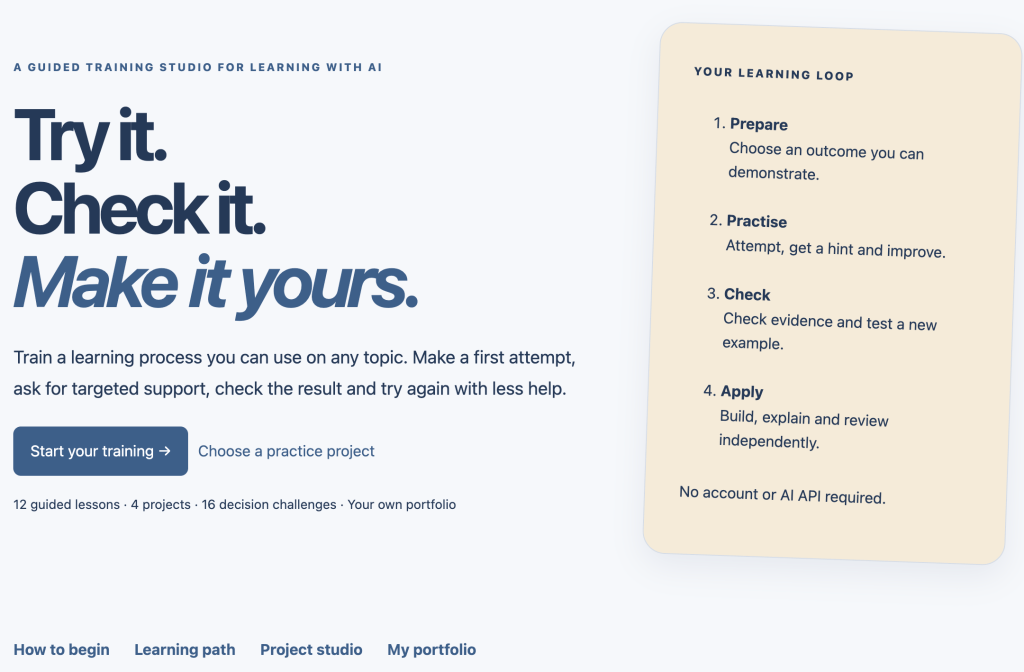
Tool 1: Practice Coach — Make Every Practice Session Count
For learners who want to move beyond reading and watching into active skill development.
Practice Coach is a resource to explore when you’re ready to focus on the practice stage of learning.
The principles discussed in this article provide a useful starting point for approaching practice more intentionally.
Instead of practicing without direction, begin each session by defining a specific objective.
For example:
- Learn to write a JavaScript function without copying an example.
- Improve the clarity of a paragraph through independent revision.
- Explain a mathematics concept without consulting notes.
- Practice responding to a realistic workplace scenario.
- Strengthen your understanding of a new subject through questions and exercises.
A useful practice session should include an attempt, feedback, and an opportunity to improve.
Explore Practice Coach:
https://vibelearning.ca/tools/practice-coach
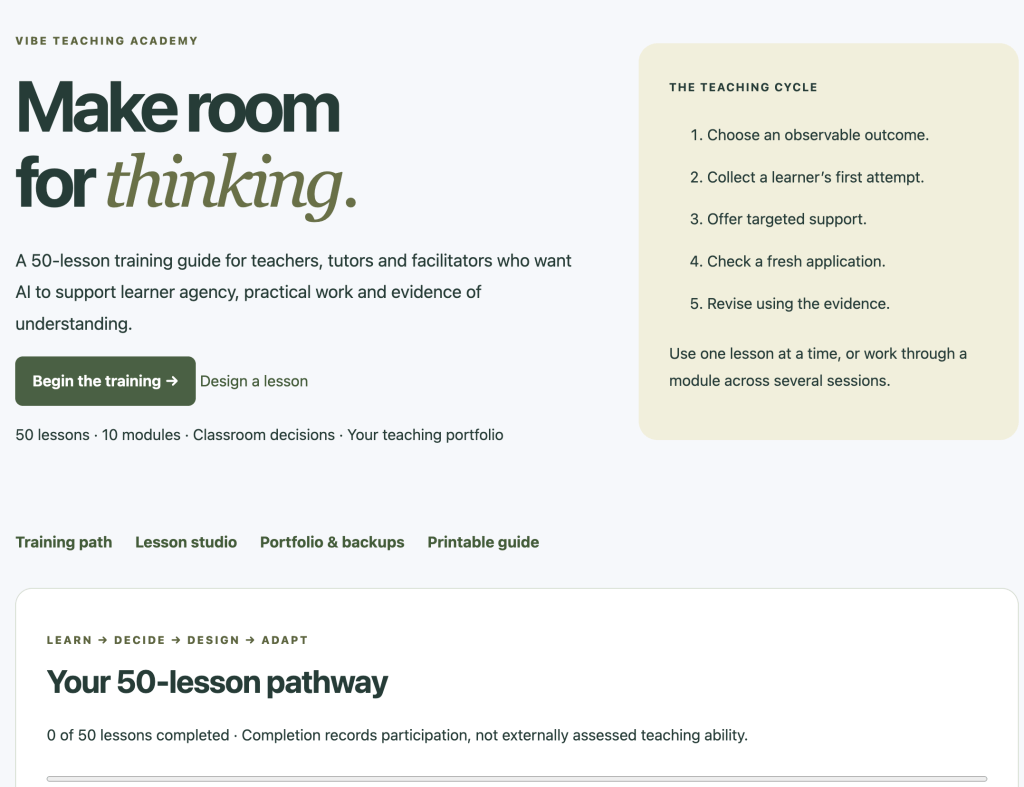
Tool 2: Vibe Teaching Academy — Explore AI-Supported Teaching
For educators, trainers, course creators, and anyone interested in helping others learn.
Vibe Teaching Academy is a resource for exploring the Vibe Teaching approach and its application to AI-supported education.
The ideas introduced throughout this article are particularly relevant to teaching.
Educators can begin by examining how they structure learning experiences.
Ask yourself:
- Am I giving learners enough opportunities to practice independently?
- Are my activities testing understanding or simply recognition?
- How can I make feedback more specific and actionable?
- Where could AI help me create better examples and exercises?
- How can I encourage learners to reflect and take ownership of their progress?
These questions provide a foundation for designing learning experiences that go beyond information delivery.
Explore Vibe Teaching Academy:
https://vibelearning.ca/tools/vibe-teaching-academy
Final Thoughts: The Future of Learning Is Active
Artificial intelligence is changing how quickly we can access information.
But faster access doesn’t automatically create deeper understanding.
Learning still requires curiosity, effort, experimentation, practice, and reflection.
The real opportunity is to use AI to make those activities more accessible, engaging, and productive.
For learners, that means becoming active participants in developing their own skills.
For teachers, it means creating experiences that encourage reasoning, practice, feedback, and growth.
And for anyone interested in lifelong learning, it means recognizing that the goal isn’t simply to collect more information.
The goal is to develop the ability to understand, apply, create, and keep improving.
That’s the direction behind Vibe Learning and Vibe Teaching.
Start with something you want to learn.
Ask better questions.
Practice deliberately.
Learn from feedback.
And keep building on what you discover.
Continue Your Learning Journey
Explore the Vibe Learning Framework and its learning resources:
Vibe Learning: https://vibelearning.ca/
Practice Coach: https://vibelearning.ca/tools/practice-coach/
Vibe Teaching Academy: https://vibelearning.ca/tools/vibe-teaching-academy/
Written by Laurence Lars Svekis — Developer, educator, author, Google Developer Expert, and creator of the Vibe Learning and Vibe Teaching frameworks. Laurence has taught more than 3 million students through online learning resources and courses.
Join the Conversation
What do you think is the biggest challenge in learning with AI?
Is it finding the right information, getting enough practice, receiving useful feedback, or knowing whether you’ve truly mastered a skill?
Share your thoughts and experiences.
#VibeLearning #VibeTeaching #ArtificialIntelligence #AILearning #AIEducation #EdTech #LifelongLearning #LearningStrategies #ActiveLearning #DeliberatePractice #TeachingWithAI #AIForEducation #FutureOfEducation #SkillDevelopment #PersonalizedLearning #EducationInnovation #LaurenceSvekis