https://vibelearning.ca/learn-how-to-learn
AI can explain almost anything.
That doesn’t necessarily mean we are learning.
We can ask a question, get an excellent explanation, read it, understand it in the moment—and forget most of it a few days later.
We can ask AI to solve a problem, improve our writing, debug our code, summarize a difficult concept, or create a learning plan.
But there is an important question hiding underneath all of this:
Did AI help us learn, or did it simply help us finish?
That distinction is at the heart of Vibe Learning.
And it is why I created a new free interactive resource:
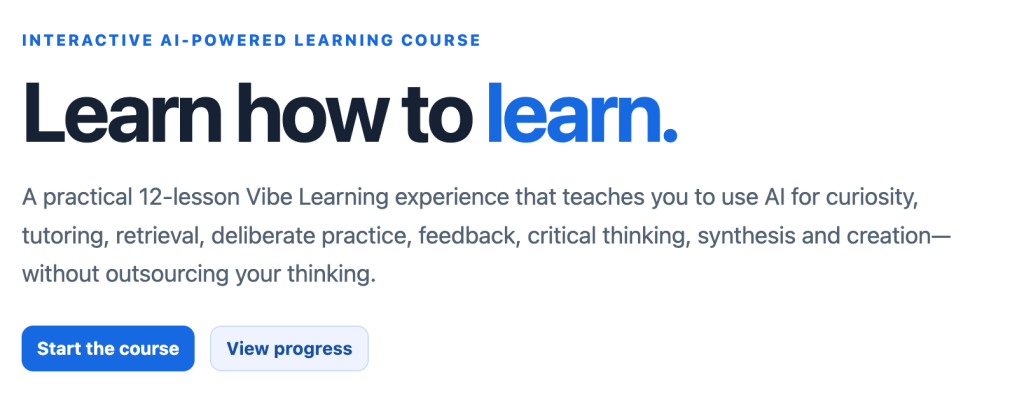
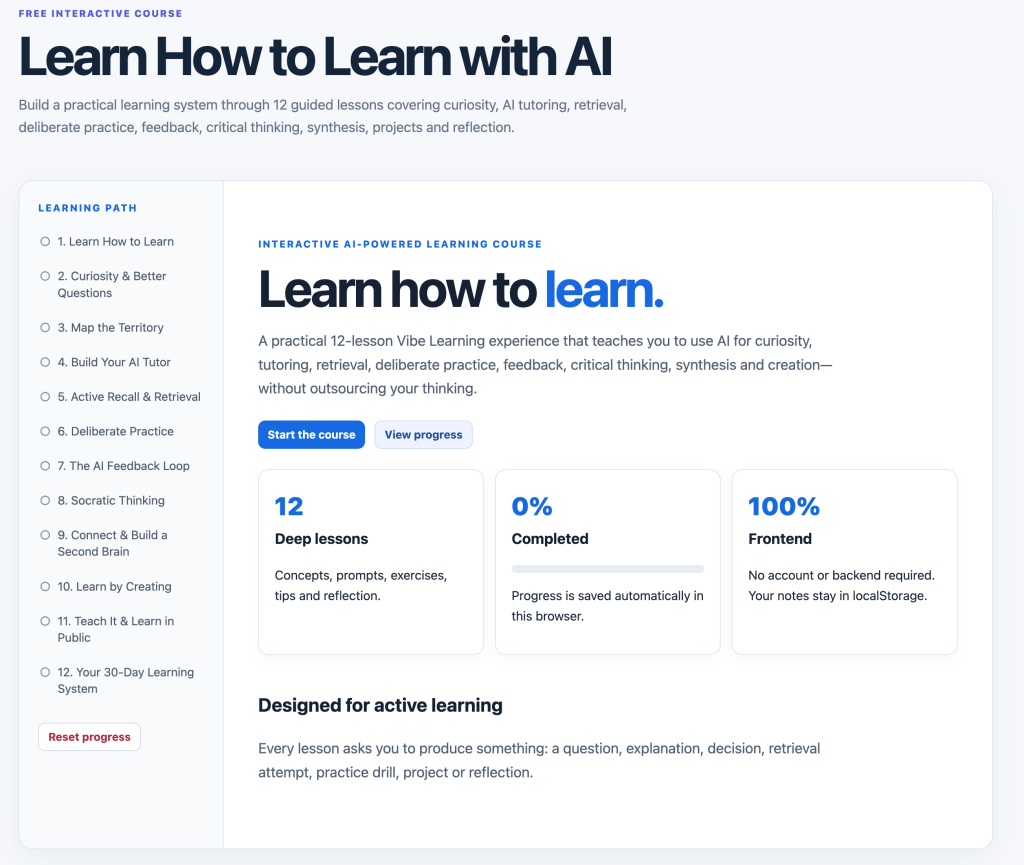
Learn How to Learn
I wanted to build something different from another collection of articles or another AI prompt generator.
The goal was to create an interactive learning experience that teaches you how to become a better learner while using AI.
The course takes you through a structured learning path where you don’t just read about learning techniques.
You actually use them.
You answer questions.
You make predictions.
You retrieve ideas from memory.
You design practice.
You reflect on mistakes.
You create projects.
You teach concepts back.
And you gradually build your own personal learning system.
The Problem with AI-Assisted Learning
AI has made information incredibly easy to access.
That is useful—but convenience can also remove some of the mental work that makes learning effective.
Imagine that you’re learning JavaScript.
You encounter a programming problem.
You could immediately ask AI:
Fix this code.
You’ll probably get working code.
But compare that with a different process:
First, predict what is wrong.
Try to fix it yourself.
Explain your reasoning.
Ask AI for a hint rather than the answer.
Try again.
Then ask AI to analyze the mistake.
Finally, solve a similar problem without assistance.
The second process takes longer.
But it creates something much more valuable:
capability.
That’s the principle behind the Learn How to Learn course.
The Vibe Learning Flywheel
The course introduces a learning cycle that you can reuse for almost any subject:
Curiosity → Explore → Understand → Practice → Feedback → Reflect → Connect → Create → Share → Reinvent
The important idea is that learning isn’t a straight line.
You continuously move between understanding, attempting, receiving feedback, making connections and creating.
AI can participate throughout this cycle.
But it shouldn’t replace the learner.
Instead, AI can become your:
- tutor
- questioning partner
- practice generator
- feedback coach
- retrieval partner
- project coach
- thinking challenger
The learner remains responsible for the thinking.
12 Interactive Lessons
The course is organized into 12 practical lessons.
You begin by designing your personal learning system and then progressively explore better questions, learning maps, AI tutoring, active recall, deliberate practice, feedback loops, Socratic thinking, knowledge connections, creation, teaching and long-term learning planning.
One lesson might ask you to define what you want to become capable of doing.
Another asks you to design questions around something you’re learning.
Another helps you create an AI tutor that gives hints before solutions.
Later lessons challenge you to retrieve information without looking at your notes, deliberately practice weaknesses, analyze feedback patterns, create projects and explain concepts in your own words.
The idea is simple:
Every lesson should make you do something.
Reading is only the beginning.
Build an AI Tutor That Doesn’t Just Give Answers
One of my favorite parts of the course is learning how to change AI’s role.
Instead of saying:
Teach me JavaScript.
You can establish a learning relationship.
For example, your AI tutor can first determine what you already understand.
Then it can introduce one concept at a time.
Instead of immediately solving problems, it can ask what you tried.
If you’re stuck, it can provide a small hint.
Still stuck?
A more specific hint.
Then perhaps a related example.
The complete answer comes only when it is actually needed.
This changes AI from an answer machine into a learning partner.
Active Recall Instead of Endless Rereading
Another major part of the course is retrieval.
Reading something repeatedly can make it feel familiar.
But familiarity isn’t the same as being able to use the knowledge.
Try this instead.
Learn something.
Close your notes.
Then explain it.
Answer a question about it.
Solve a problem using it.
Draw the concept from memory.
Teach it to someone else.
Only after attempting retrieval should you check what you missed.
AI is extremely useful here because it can continuously generate new questions and variations without revealing the answers first.
Learn Through Feedback
Feedback is another place where AI can either strengthen learning or accidentally remove it.
Suppose you write something and ask:
Make this better.
AI rewrites it.
Your document may improve.
But did you improve?
A stronger feedback loop is:
Attempt → Diagnose → Prioritize → Revise → Compare → Reflect → Repeat
Instead of rewriting your work, AI identifies the highest-impact weakness.
You make the revision.
Then AI compares the two attempts.
Now feedback becomes practice.
Learn by Creating
Eventually, learning needs to leave the lesson.
You need to build something.
If you’re learning programming, build an application.
If you’re learning writing, publish an article.
If you’re learning design, create a design.
If you’re learning a business concept, build a small strategy around it.
Projects reveal gaps that explanations often hide.
You suddenly discover:
“I understand this idea—but I don’t know how to actually use it.”
That’s useful information.
The project becomes part of the learning process.
Teach It Back
One of the most powerful tests of understanding is also one of the simplest:
Explain the idea yourself.
No copying.
No notes.
No AI-generated explanation.
Teach it back in your own words.
Then ask AI to identify what was missing, inaccurate or unclear.
Correct the explanation and try again.
This turns AI into an evaluator of your understanding rather than the source of your understanding.
That’s an important difference.
Your Learning Progress Stays with You
The interactive course also lets you work through exercises, record reflections and track lesson completion.
The goal is to make the experience feel less like reading a website and more like working through a learning lab.
You can move lesson by lesson and gradually construct a learning process that works for you.
Try It With Something You Actually Want to Learn
Don’t go through the course using an imaginary topic.
Pick something real.
Something you’ve wanted to understand.
Maybe it’s:
JavaScript.
AI.
Google Apps Script.
Photography.
Writing.
Mathematics.
Design.
Marketing.
A new language.
Or something completely different.
Then take that subject through the lessons.
Ask better questions about it.
Map it.
Practice retrieving it.
Find your weaknesses.
Get feedback.
Build something.
Explain what you’ve learned.
Then identify what you need to learn next.
That’s where the course becomes much more than a course about learning.
Your chosen topic becomes the laboratory.
A Different Relationship with AI
I think one of the biggest opportunities with AI isn’t simply getting better answers.
It’s creating better learning experiences.
AI can give us explanations on demand.
But it can also challenge us.
Question us.
Generate practice.
Expose misconceptions.
Adjust difficulty.
Help us reflect.
Connect ideas.
And give us feedback at exactly the moment we need it.
The difference comes from how we choose to use it.
The objective of Vibe Learning is not:
AI does the work.
It’s:
AI helps you become better at doing the work.
That is what I wanted this interactive course to help people practice.
Start the Free Interactive Course
Learn How to Learn with AI
Work through the lessons, complete the exercises, experiment with the AI prompts and apply the techniques to something you genuinely want to learn.
The goal isn’t to finish as quickly as possible.
The goal is to finish with a learning system you can keep using.
Start here:
https://vibelearning.ca/learn-how-to-learn
Learn.
Practice.
Get feedback.
Reflect.
Create.
Then do it again.
That’s Vibe Learning.